
( Article is written by Ms. Kuhu Kulkarni (Psychologist) & Dr. Charumati Raghavan (Neuropsychologist) )
Shilpa was 45 when a stroke shattered her world on an ordinary Sunday morning. Two harrowing months in the hospital later, she went home with left-sided paralysis. After a year of intensive physiotherapy, she could now walk short distances with a walking stick. Her family finally relaxed, convinced that the hardest part was over. Shilpa, however, avoided any talk of returning to work, was reluctant to go out, and could not manage payments or cook without help. She would freeze, unable to recall what day it was sometimes, what vegetables were in the fridge, or whether she had taken her medicine or not. While on the surface she looked like she had recovered, Shilpa felt like she could not recognise herself anymore.
Sameer, another stroke survivor, was further along in recovery; he could speak well again, walk by himself and had even returned to work part-time. His friends noticed, though, that he was no longer the ‘life of the party.’ Now, he avoided conversations, hardly ever initiating any. Activities he once loved—trekking, movies—no longer held his interest. The thought of family functions and his daughter’s parent-teacher meetings made him anxious and irritable. His wife and daughter felt that he was becoming distant.
Such instances where a person seems to have changed after a stroke are not uncommon to hear from stroke survivors and their families. Often, survivors like Shilpa and Sameer do not know how to explain their struggles because they may themselves not fully understand what is happening.
For many stroke survivors, physiotherapy, speech therapy, and occupational therapy help to re-build skills required for everyday life. Yet weeks or months later, something may still feel off like trouble focusing attention, mood changes, fatigue, feeling unusually irritable, or simply not feeling like themselves anymore. This does not mean the other therapies failed; it is because stroke recovery is more than healing the body. Whether you are the survivor noticing these changes or the family member watching them unfold, understanding that both the body and mind need attention is often the first step towards holistic recovery.
The invisible effects of stroke
Some changes following the stroke are easy to see, such as walking difficulty, speech difficulties, loss of balance or arm weakness. However, stroke can also affect less visible aspects such as memory, attention, planning, spontaneity, emotional control, confidence, and the ability to judge situations clearly. These changes are often harder to recognise, especially if the survivor has become less involved in everyday life activities. However, cognitive changes can even impact understanding of how their stroke has impacted them, therapy participation, motivation and ability to enjoy hobbies, conversations, share opinions and make decisions.
Changes to behaviour and mood, such as anger, irritability, feeling overwhelmed, fatigue or withdrawing into a shell, may be considered as an understandable response to a traumatic event like a stroke. While that may be true, changes to behaviour and mood can also be because of stroke’s effects on parts of the brain involved in self-control, awareness, empathy and emotional regulation.
These cognitive and psychological changes are very common. A survey carried out with 30 stroke survivors and caregivers via Stroke Support India showed that 87-90% participants had cognitive and psychological difficulties post stroke, numbers that are comparable to physical (93%) and speech difficulties (87%). However, while 93% survivors availed of physiotherapy and 50% took up speech therapy, only 7% of survivors availed of therapy for cognitive and behaviour difficulties. The most common reason given for this by 88% respondents was a lack of awareness that such a service even exists. This finding underlines the need to increase conversations and disseminate information about the cognitive and psychological changes
that stroke may bring with it, to empower those affected to seek help with addressing them.
How Neuropsychological Rehabilitation Helps
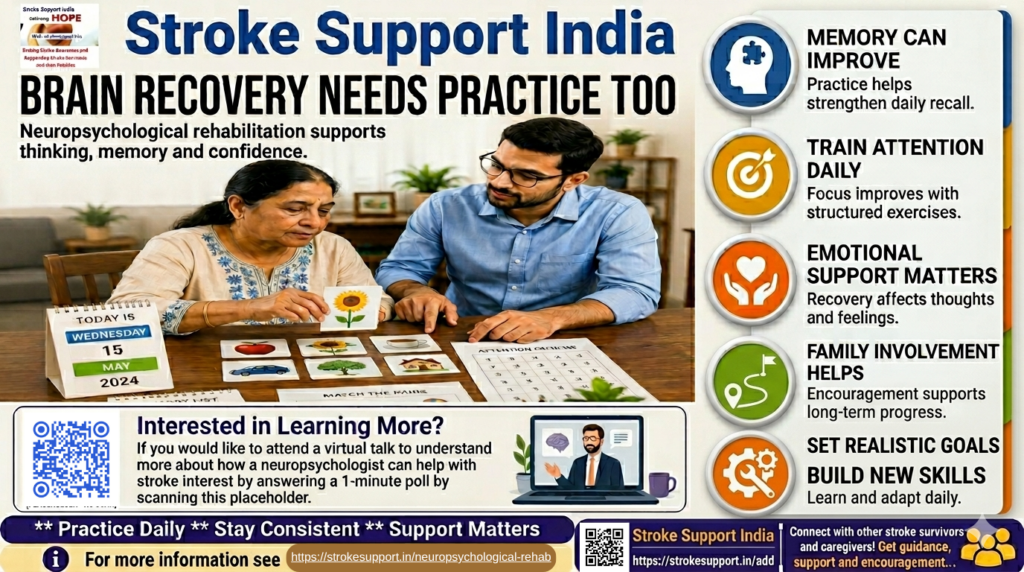
Neuropsychological rehabilitation is a form of therapy that can help stroke survivors restore or adapt to cognitive, emotional and behaviour changes brought about brain injuries like stroke. In practice, neuropsychological rehabilitation begins with an interview about the person’s daily struggles, followed by an understanding of how memory, attention, planning, mood, behaviour, confidence, and adjustment may affect their daily life. A formal evaluation using standardized tests for cognitive abilities is often undertaken to identify the stroke survivor’s current strengths and weaknesses in thinking and memory. The neuropsychologist then helps the family and survivor understand these findings, helps to set meaningful goals for rehabilitation and provides practical strategies and support over multiple sessions. Strategies used are evidence- based and the neuropsychologist’s expertise is to help with person-centred application of these strategies. For the caregiver, the neuropsychologist offers education on the hidden effects of stroke, guidance on how to respond more helpfully at home, and support.
Thus, neuropsychological rehabilitation has the potential to improve not only functioning but also the quality of life for the family. While not all stroke survivors may acquire all the lost functions back fully, helping them understand their challenges, work on personally meaningful goals and adjust to life after stroke are important aspects of rehabilitation.
What can you do?
If these struggles sound familiar, the next step is to ask for help early. Families can speak to the treating neurologist, rehabilitation doctor, or their stroke team and ask whether a neuropsychological assessment or rehabilitation is available. It can also help to keep a few examples of day-to-day difficulties, such as repeated confusion, irritability, forgetfulness, withdrawal, or trouble returning to work, because this gives the clinician a clearer picture of what is happening.
The process of stroke recovery can be confusing, but with the right support, families can learn what is happening and find better ways to cope day to day. Support is also most helpful when the family is involved in the care cycle. Learning how cognitive impairments can affect their loved one not only helps with providing better support but can also improve the quality of communication and connection with their loved ones.
If you would like to attend a virtual talk to understand more about how a neuropsychologist can help with stroke rehabilitation, indicate your interest by answering the poll in this link (estimated time to answer=1 minute):
https://forms.gle/8Yr4F1etZMR32uRYA
Any experiences to share on the above ? Please put here or join our Telegram groups as under for ongoing discussions. Join other Stroke and Aphasia Survivors, Caregivers and equipment/service providers for help, encouragement , knowledge sharing and most importantly – hope – via: ** Telegram Groups: https://strokesupport.in/add/ ** ALL other means to connect with us, including Social Media Groups and Channels on Telegram, LinkedIn, Facebook ( in many local Indian Languages) , Twitter, Instagram, Pinterest and YouTube ; as well as means of Volunteering, giving Feedback, sharing your inputs etc. may all be found at : https://strokesupport.in/connect/ Please DO have a look and join in wherever convenient as well as share.Thank you VERY MUCH !